


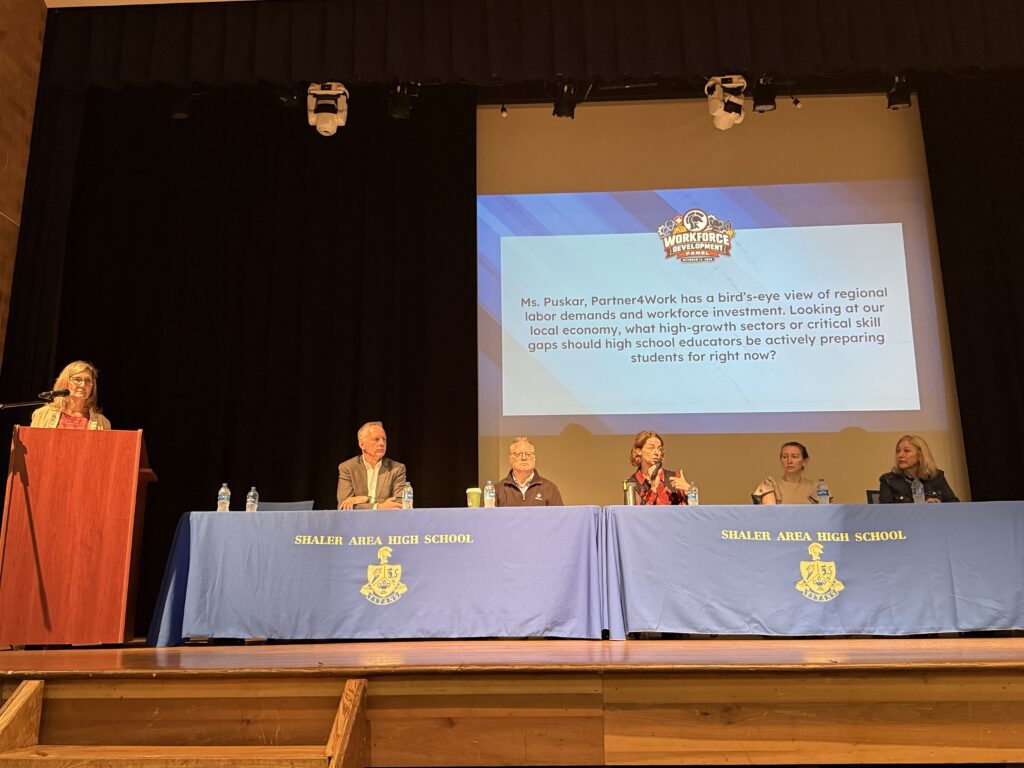
Shaler Area School District is committed to making sure every Titan graduates ready for what comes next. In October, the district hosted a Workforce Development Panel at Shaler Area High School, inviting high school faculty to hear directly from regional leaders in education, the skilled trades, healthcare, construction, and workforce policy.
The conversation centered on a timely question: how can high schools best prepare students for a workplace shaped by rapid technological change, automation, and evolving skill requirements? Panelists shared practical, actionable strategies to help schools cultivate graduates who are adaptable, confident, and career-ready.
Jackie Foor, Chief Executive Officer of the Consortium for Public Education, moderated the discussion, drawing on her organization’s work connecting K–12 schools with regional employers, higher education, and community resources. She was joined by Rachel Hienz, Joint Apprenticeship Training Coordinator and Assistant Training Director with the International Brotherhood of Electrical Workers, who spoke to the value of union pre-apprenticeship pathways and hands-on learning in the skilled trades. Samantha Young, Pre-Health Professions Advisor at the University of Pittsburgh, offered insight into how strong high school science and lab instruction lays the groundwork for success in college and the health professions.
Dr. Michael Reed, President of Pennsylvania College of Technology, highlighted applied degree pathways and the industry partnerships that help technical graduates find meaningful careers. Dan Kiefer, Chief Estimator at Massaro CM Services, LLC, shared the competencies major regional contractors look for in modern construction management and capital project planning. Rounding out the panel, Susie Puskar, Chief Operations Officer of Partner4Work, provided a big-picture view of regional labor market trends and the high-growth sectors driving opportunity across Pittsburgh and Allegheny County.
Several clear themes emerged. Employers placed a strong emphasis on durable skills such as communication, decision-making, resilience, and problem-solving, noting that these qualities will only grow in importance as artificial intelligence reshapes the economy. Panelists also called for deeper partnerships among high schools, local employers, trade apprenticeships, and higher education institutions so students can gain authentic, real-world exposure to careers before graduation. Finally, the group discussed the expanding range of pathways available to students today, from dual enrollment and pre-apprenticeships to micro-credentials and applied learning models, all designed to ensure smooth transitions after high school.
For Shaler Area faculty, the panel offered valuable perspective to bring back into the classroom. By listening to the people who hire, train, and teach the next generation of workers, the district continues to strengthen the connection between what students learn today and the opportunities waiting for them tomorrow.
Shaler Area extends its sincere thanks to each panelist for sharing their time and expertise. This collaboration reflects the district’s ongoing mission to Engage, Empower, and Excel, and its dedication to preparing every student for a successful future, whatever path they choose.